

By Darby Kendall
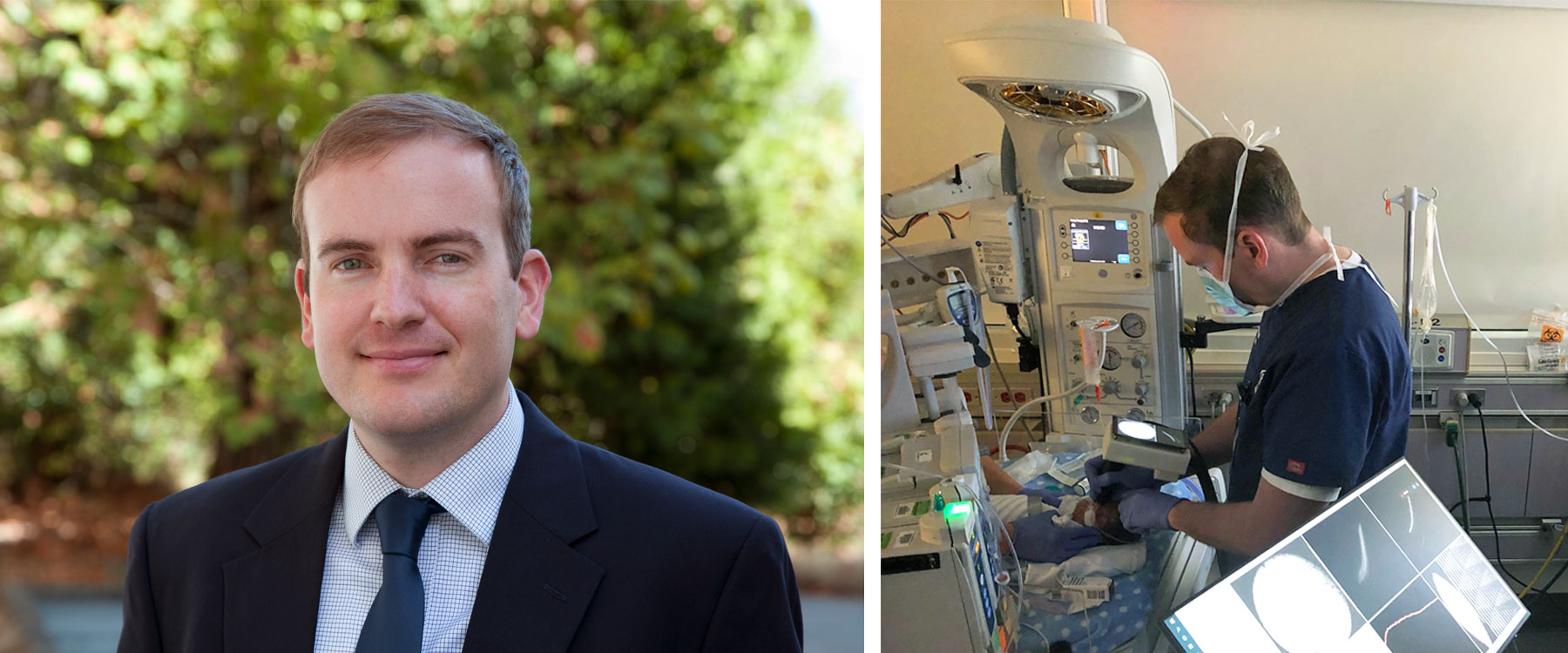
OHSU’s Casey Eye Institute is globally renowned for groundbreaking advancements in eye health and care. J. Peter Campbell, M.D., M.P.H., the Edwin and Josephine Knowles Professor of Ophthalmology, researches and utilizes technology to improve the care of those with retinal disease, including pediatric patients. Following decades of the Casey Eye Institute’s leadership in retinopathy of prematurity (ROP) research and screening methods, Campbell and his colleagues are addressing a critical gap in pediatric retinal care.
Here are some highlights from Campbell speaking at a recent conference on ROP and the sight-saving exams and treatments happening at the Casey Eye Institute.
Support ROP research

Transcript
I want you to paint a mental image in your head. I want you to imagine the University of Oregon football stadium on a Saturday in the fall. I want you to imagine 50,000 people getting ready to watch a game of football. Now, I want you to imagine they’re blind and can’t see. It kind of changes the energy a little bit. I want to go one step further and ask you to imagine that each of those persons is a little baby that’ll grow up not being able to see. This isn’t just a tragic thought experiment. 50,000 is the number of babies who go blind from a condition called retinopathy of prematurity, or ROP, every year around the world. This one makes me passionate, because the number could be closer to zero.
OHSU’s Casey Eye Institute is globally renowned for groundbreaking advancements in eye health and care. Dr. Peter Campbell, the Edwin and Josephine Knowles Professor of Ophthalmology at the Casey Eye Institute, researches and utilizes technology to improve the care of patients with retinal disease, including pediatric patients. Here are some highlights from Dr. Campbell speaking at a recent conference on retinopathy of prematurity and the sight-saving screenings and treatments happening at OHSU.
So, ROP is a disease of success. It’s an iatrogenic disease. We cause it by saving the lives of prematurely born infants. Now, in order to keep those babies alive, they require neonatal intensive care, require high doses of oxygen, because their lungs aren’t ready to deliver oxygen to the rest of the organs in their body. But that oxygen can cause problems. You see, the eye is used to developing in a low-oxygen intrauterine environment and doesn’t finish developing until term. When it’s exposed to those levels of oxygen earlier, the eye gets confused and stops developing normally and starts developing abnormally in ways that are incompatible with vision permanently. That’s what ROP is.
Stevie Wonder went blind from ROP 75 years ago. At that time, we didn’t know what this disease was. We didn’t know how to diagnose it before it caused blindness or whether it was treatable. We know all of that now. And since then, treatments have gotten much, much easier, such that now a single injection can save the life of a baby with a medicine that’s available in every country where this is a problem. So, why are 50,000 babies still going blind in 2026? Well, it’s because even though we know so much about ROP, the way we diagnose the disease hasn’t changed since Stevie Wonder went blind.
What do I mean by that? To diagnose ROP, we have to go to the bedside of every baby at the NICU where they are, dilate their eyes, put a speculum in to hold the eyes open, push on the eye with a metal instrument, because when we wear the ophthalmoscope on our head and shine a really bright light in the back of the eye, we get a really small field of view. It’s a really challenging skill to learn. Not a lot of ophthalmologists want to do it. In fact, even in the U.S., ophthalmology graduates don’t feel comfortable managing this condition without additional training. If the doctor doesn’t see the disease, or they get it wrong, or there’s no doctor at the bedside of that baby when they need to be seen, babies go blind.
So, we’re at OHSU. I get to work with David Huang, work with one of his colleagues, Yifan Jian, who, for the past six years, he and I have been trying to solve this problem. The eye exam has changed dramatically over the past 20 years. The standard of care 20 years ago was to look in the back of the eye and draw what you see with colored pencils. You won’t find colored pencils at Casey Eye Institute anymore, and that’s because of Dr. Huang’s work. The OCT and ultra-wide field imaging have changed the way we care for adults with retinal diseases. But on Wednesdays, when I go to the NICU and screen for babies with ROP, prior to a few years ago, it was still colored pencils.
So, working with Yifan Jian, my colleague, we’ve developed the world’s first handheld ultra-widefield OCT, specifically designed to diagnose ROP in only a few seconds. We can see the entire eye in three dimensions at the cellular resolution, better than my eyes. Just like OCT for adults has made it that it’s better than our eye exam, we’re now seeing the same thing in children. We’ve done more than 3,000 eye exams at OHSU, and it’s the only place in the world that has access to technology right now. Nurses love it, parents love it, because it’s less stressful. Babies don’t love it, but it’s better than the alternative, and it is the future.
But that doesn’t yet solve the problem, because OCT, as amazing as it is, is not an inexpensive technology; it doesn’t solve that cost problem. What we really need is a low-cost ultra-widefield imaging device that we can use on babies. So, we’re making that too. Orbis International, the world’s largest eye NGO, has invested in our team and in the company to solve this problem by creating a low-cost hardware platform that’s capable of ultra-widefield imaging with a target goal of $1,000 — low enough that we could place that device in every NICU in the world.
So, our thesis is simple. I believe ROP blindness is a solvable problem in this generation. We know where the babies are that need to be treated, we know how to treat them if they can be found, and we now have the infrastructure that’s scalable to solve this problem.
Patient Care

Community | Patient Care
Patient Care